
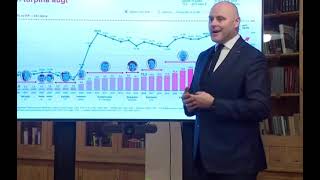

Merging the Faculty of Environment and Civil Engineering with the Faculty of Forestry, the Faculty of Forest and Environmental Sciences will commence its operations on 1 September, led by Dean Professor Linards Sisenis. Forestry is already inseparable from landscape planning and environmental sciences. I believe that by working together, we will only gain. Furthermore, by combining wood processing with civil engineering, we will have the capacity to develop timber construction without losing our classic civil engineering programmes, but rather developing them further. The land management and geodesy unit will serve to help us develop specific IT areas, which are currently a bottleneck in forestry education. Working together will also make it easier to attract funding for science and projects; in summary, I clearly see benefits for all study and scientific disciplines represented in the new faculty by merging the faculties, says L. Sisenis, Dean of the combined Faculty of Forest and Environmental Sciences.
(Linards Sisenis: “I see benefits in merging the faculties”. ZZ.lv)
“Structural changes at the university, reorganising the number of faculties from eight to five, are being implemented with the aim of promoting the implementation of a unified university development strategy,” says LBTU Rector Irina Pilvere. This will strengthen existing study programmes whose graduates are in demand on the labour market, and will open up broader opportunities for the creation of new programmes.
(From September, LBTU will implement several structural changes. LBTU)
The merging of the faculties also involves structural changes within the faculties themselves, through the creation of four institutes. By combining two departments, Landscape Architecture and Planning, and Environment and Water Management, the Institute of Landscape Planning and Environmental Engineering will be formed. It will continue to run the academic bachelor's study programme “Landscape Architecture and Planning”, the professional bachelor's study programme “Environment and Water Management”, the professional master's study programme “Landscape Architecture and Planning”, the academic master's study programme “Environmental, Water and Land Engineering” (in cooperation with the Institute of Land Management and Geodesy), and the doctoral study programmes “Landscape Architecture” and “Environmental Engineering”. The strengths of the institute are its two unique study branches, “Landscape Architecture” and “Land Reclamation”, which can only be studied at LBTU in Latvia, with the added opportunity to obtain an engineer's qualification and apply for a construction specialist certificate in the relevant field.
The Institute of Land Management and Geodesy will run two professional bachelor's study programmes, “Geoinformatics and Remote Sensing” and “Land Management and Surveying”, as well as the academic master's study programmes “Environmental, Water and Land Engineering” (in cooperation with the Institute of Landscape Planning and Environmental Engineering) and “Geoinformatics and Remote Sensing”. The fundamental and highly experienced field of land management and surveying, combined with the new and robust field of geoinformatics, opens a new chapter in the world of modern technology.
By merging three thematically related departments—the Department of Architecture and Civil Engineering, the Department of Structural Engineering, and the Department of Wood Processing—the Institute of Modern Construction and Wood Processing has been created. It will run the professional 1st-level part-time study programme “Construction”, the professional bachelor's study programmes “Construction” and “Wood Processing”, the professional master's study programme “Construction”, the academic master's study programme “Wood Materials and Technology”, as well as two doctoral study programmes, “Civil Engineering Science” and “Wood Materials and Technology”. The focus on wooden buildings, structures and wood processing, combined with a broad understanding of various building structures, materials, and load calculations, provides a solid foundation for the institute's future development in the fields of science and practical research.
The Institute of Forestry will combine the Department of Forest Utilisation and the Department of Silviculture and will run the professional bachelor's study programme “Forest Engineer”, the academic bachelor's study programme “Forest Science”, the professional master's study programme “Occupational Protection and Safety”, the academic master's study programme “Forest Science”, and the doctoral study programme “Forest Science”. Strong support and involvement from the forestry sector enhance the quality of study programmes and public interest, providing the opportunity to prepare highly sought-after and competitive specialists.
The goal of the combined faculty is to provide students with scientific, academic, and professional education and to conduct scientific research in scientific fields related to forestry science, civil and environmental engineering, landscape architecture, and materials science.
Changes always create room for questions and reflection. The most important thing is that the answers and conclusions lead towards growth!